
Powder Coating vs Paint for Fences Gates and Railings Which Lasts Longer

Outdoor metal takes abuse every day. Fences sit in rain and sun. Gates scrape at hinges and latches. Railings get touched, bumped, and knocked with tools, bikes, strollers, and yard equipment. Spiral staircases add foot traffic, hand wear, and tight corners where moisture can sit.
So when the question is powder coating vs paint for fences gates and railings, the answer needs to be practical, not broad.
For most new metal fences, gates, handrails, guardrails, balcony rails, and spiral staircases, powder coating lasts longer than standard paint when the metal is prepared correctly and the right powder is used. It forms a harder, thicker, more even finish that resists chipping, scratching, fading, and corrosion better than most liquid coatings.
Paint still has a place. It is easier to repair on-site, better for some already-installed metalwork, and often the realistic choice for older wrought iron that cannot be removed and baked in an oven.
The best choice depends on whether the metal is new or existing, where it will be installed, and how much wear it will take.
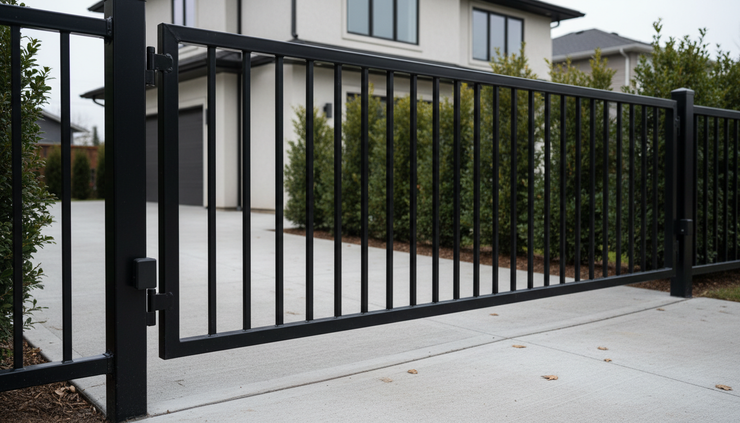
Powder coating usually lasts longer on new metalwork
Powder coating is a dry finishing process. The metal is cleaned, the powder is applied with an electrostatic charge, and the part is baked so the coating flows and cures into a solid film.
That curing step is the main difference. Paint dries. Powder coating cures.
On fences, gates, railings, and spiral staircases, that cured finish gives several real advantages:
Better impact resistance
A gate latch, railing post, or stair stringer is more likely to survive daily bumps without exposing bare metal.
More even coverage
Powder wraps around posts, pickets, scrolls, brackets, and welded joints better than many sprayed paints.
Thicker film build
Powder coating often creates a thicker protective layer in one application than standard paint does in one coat.
Strong color retention
Exterior-grade polyester powders hold up well against sun exposure when the correct product is used.
Cleaner factory finish
New panels, rails, and stairs can be finished before installation, which allows better access to corners and undersides.
For a newly fabricated steel fence or aluminum railing, powder coating is usually the longer-lasting and better-looking option. It gives the metalwork a finished, uniform appearance that is hard to match with brush or roller paint.
The catch is preparation. Powder coating is only as good as the surface beneath it.
If mill scale, oil, welding residue, rust, or moisture stays on the metal, the coating can fail early. Good powder coating work starts with proper cleaning, blasting or pretreatment where needed, and careful handling before the parts go into the oven.
Paint is easier to repair, but it usually needs more maintenance
Paint is more familiar. It can be brushed, rolled, or sprayed. It can be applied on-site. It does not require an oven. That makes it useful for installed fences and railings that cannot be removed without major labor.
For older metalwork, paint may be the practical choice.
A long fence already set in concrete, a balcony railing welded into place, or a spiral staircase inside a finished home may not be a good candidate for powder coating unless the parts can be taken apart and transported to a shop.
Paint also wins when small repairs are the priority. If a painted gate gets scratched, the repair can be simple:
Sand the damaged area.
Remove rust.
Prime exposed metal.
Apply matching paint.
A powder coated part can also be touched up, but the repair is usually done with liquid touch-up paint, not more powder. It may protect the spot, but it rarely blends as perfectly as the original factory finish.
That matters on highly visible pieces, such as front entrance gates, decorative railings, and interior spiral staircases.
Still, paint has a weakness outdoors. It tends to be thinner, softer, and more vulnerable to chips and peeling, especially if the primer or surface prep is poor. Once water reaches bare steel, rust spreads under the coating. On railings and fences, that often starts at welds, cut ends, fastener points, and lower sections close to soil or concrete.
How each finish performs on fences
Fences have one big challenge: exposure from all sides.
A metal fence may face full sun on one side, shade and moisture on the other, and irrigation spray near the bottom. If the fence is near a road, it may also deal with dust, grime, and winter de-icing residue in colder regions.
Powder coating performs well on new fence panels because the entire panel can be coated before installation. Pickets, rails, and welded joints get a continuous finish, which helps slow corrosion.
This is especially useful for:
Steel fence panels
Aluminum fencing
Ornamental iron-style fencing
Pool fencing
Decorative front yard fencing
Commercial perimeter fencing
Paint can work well when the fence is already installed, but the process needs patience. Rust must be removed, not just covered. Bare steel needs primer. Thin spots around welds and pickets need extra attention.
The most common paint failure on fences is not the broad face of the rail. It is the small places where prep is difficult:
Inside corners
Weld beads
Bottoms of pickets
Screw and bolt holes
Areas close to sprinklers
Places where vines or soil trap moisture
For a new fence, choose powder coating if budget allows. For an old fence that is still structurally sound but already installed, a careful repaint may make more sense than removing every panel.

How each finish performs on gates
Gates work harder than fence panels. They move, swing, latch, drag, vibrate, and get touched constantly. A driveway gate or garden gate has stress points that a fixed fence does not.
The finish usually fails first around:
Hinges
Latches
Drop rods
Lock boxes
Handle areas
Bottom rails
Corners that hit stops or posts
Powder coating is a strong choice for new gates because it resists abrasion better than most standard paint. A good powder coated gate can also look more consistent across flat bars, posts, scrolls, and decorative details.
For gates, coating thickness and prep are especially important. The gate should be fully fabricated before finishing whenever possible. Cutting, drilling, or welding after powder coating exposes raw metal and creates future rust points.
Paint has one clear advantage on gates: field repair.
If a latch scratches the finish, paint touch-up is easier and less noticeable when the whole gate is painted. With powder coating, the original finish may still last longer, but touch-ups around hardware can stand out if the color or sheen does not match.
For heavy-use gates, the best long-term approach is often:
Powder coat the gate before installation.
Use quality hinges and correctly aligned hardware.
Add bumpers or stops where metal would hit metal.
Keep touch-up paint for chips at latches and fasteners.
Inspect moving parts once or twice a year.
A durable finish helps, but a poorly adjusted gate will damage any coating.
How each finish performs on railings
Railings are high-contact surfaces. Hands, rings, bags, tools, and furniture all scrape across them. Exterior railings also catch water at posts, brackets, and base plates.
Powder coating is usually the better finish for new railings because it creates a hard, smooth surface that handles regular contact well. It is commonly used for:
Exterior handrails
Balcony railings
Stair railings
Guardrails
Porch rails
Pool area railings
Aluminum rail systems
For steel railings, corrosion protection starts before the topcoat. If the railing will be outdoors, ask what prep or primer system will be used under the powder. In tough environments, a zinc-rich primer or proper pretreatment can make a big difference.
Paint can still be a good choice for railings that are fixed in place. It is also useful when matching an old finish, preserving a historic look, or refreshing a railing without removing it.
Interior railings are a closer call. Since they do not face rain or UV exposure, high-quality paint can last a long time indoors. Powder coating still gives a tougher factory finish, but paint may be easier if the railing is already installed.
The main concern with railings is not just how the finish looks. It is whether the coating protects the metal where people cannot easily see damage, such as behind brackets and under base plates.
How each finish performs on spiral staircases
Spiral staircases deserve their own discussion because they combine railing wear, foot traffic, tight curves, and many connection points.
A spiral staircase may include:
Center pole
Treads
Balusters
Handrail
Landing rail
Brackets
Bolts and collars
Powder coating is usually the best finish for a new metal spiral staircase, especially if it will be outdoors. The powder can cover curved handrails, balusters, tread supports, and the center column with a consistent finish before assembly.
That said, treads are different from rails.
Walking surfaces take more direct abrasion than vertical parts. If the treads are metal and coated, the front edges and high spots may wear faster than the handrail or balusters. For exterior spiral stairs, safety also matters. A smooth coated tread can become slippery when wet unless it has the right tread design, texture, or grip surface.
For spiral staircases, powder coating works best when paired with smart design:
Textured or grated treads for outdoor use
Drainage that prevents standing water
Stainless or coated fasteners
Touch-up protection at bolt holes
Careful assembly to avoid scratching parts
Regular cleaning where leaves and grit collect
Paint can work for an existing spiral staircase, especially indoors. Outdoors, painted spiral stairs often need more frequent maintenance because water can sit in joints and around fasteners.

The real reason finishes fail early
People often blame the coating when the real problem is preparation or design.
A paint job can fail quickly if rust is painted over. Powder coating can fail quickly if the metal was not cleaned properly or if moisture gets under the coating at an exposed edge.
For fences, gates, railings, and spiral staircases, the biggest causes of early failure are:
Poor rust removal before finishing
No primer on bare steel where one is needed
Coating over oil, scale, or welding residue
Drilling or cutting after finishing
Scratches left untreated
Water trapped at base plates or joints
Soil, mulch, or concrete touching metal
Sprinklers hitting the same area every day
Dissimilar metals causing corrosion at fasteners
A good finish cannot fix bad drainage, constant scraping, or exposed bare steel.
This is why the best results come from planning the finish before fabrication ends. Holes should be drilled before coating. Welds should be cleaned. Sharp edges should be softened when possible because coatings tend to be thinner on sharp corners.
For outdoor steel, edge coverage matters. Corners, cuts, and welds are where rust usually starts.
Which finish lasts longer by application
Here is the practical comparison for common metalwork.
Application | Longer-lasting choice | Why |
New steel fence panels | Powder coating | Better full-panel coverage before installation |
New aluminum fencing | Powder coating | Strong color finish with good corrosion resistance |
Existing installed fence | Paint | Easier to prep and refinish on-site |
New driveway gate | Powder coating | Better resistance to handling and weather |
Old gate with latch scratches | Paint or painted touch-up | Easier spot repairs around hardware |
New exterior railing | Powder coating | Harder finish for hand contact and weather |
Existing balcony railing | Paint | Removal may not be practical |
New outdoor spiral staircase | Powder coating | Better coverage on curved and complex parts |
Interior spiral staircase | Either | Powder is tougher, paint is easier to change |
The short version is simple: powder coating is best for new metalwork, paint is best for practical repairs and refinishing installed pieces.
When paint is the better choice
Powder coating is not always the right answer.
Choose paint when the metalwork cannot be removed, transported, and baked. This is common with long fence runs, welded balcony railings, fixed stair railings, older ironwork, and large installed gates.
Paint may also be better when:
The project needs exact on-site color matching.
The surface has many old repairs.
The structure is too large for an oven.
The finish needs frequent touch-ups.
The budget does not allow removal and shop finishing.
The metalwork has historic or handmade character.
A high-quality paint system can still perform well. The key is using the right primer and topcoat for metal, removing loose rust, and applying enough coats. For exterior steel, skipping primer is almost always a mistake.
Paint also gives more flexibility. If a homeowner wants to change a railing from black to bronze, or refresh an old iron fence without major disassembly, paint is the straightforward route.
When powder coating is worth it
Powder coating is worth it when the metalwork is new, removable, or being fabricated from scratch.
It makes the most sense for:
New fence panels
Custom gates
Aluminum railings
Steel guardrails
Exterior handrails
Spiral stair kits
Balcony rails before installation
Decorative metalwork with many small parts
Powder coating also gives a cleaner look on detailed pieces. Scrollwork, pickets, rings, collars, and welded joints often look more uniform because the coating flows around the surface.
For outdoor work, ask for an exterior-grade powder. Not every powder is meant for constant UV exposure. The wrong product can chalk or fade faster than expected.
If corrosion is a concern, ask about pretreatment and primer. Steel that will live near moisture, sprinklers, pools, or coastal air needs more protection than a dry interior railing.
A strong powder coated finish is a system, not just a color.
Maintenance still matters after finishing
No finish is maintenance-free. Powder coating lasts longer than paint in many outdoor metal applications, but it still needs basic care.
Clean fences, gates, railings, and stairs with mild soap and water. Avoid harsh abrasives, wire brushes, and aggressive solvents unless the coating manufacturer allows them.
Inspect high-wear areas:
Gate latches
Hinges
Handrail curves
Stair tread edges
Base plates
Fence sections near sprinklers
Areas where plants touch the metal
Touch up chips as soon as bare metal appears. Small scratches are usually easy to control. Ignored scratches become rust spots, and rust spreads.
Keep soil and mulch away from metal posts and bottom rails. Trim plants so leaves do not hold moisture against the finish. Adjust sprinklers so they do not spray metal every day.
For gates, check alignment. A dragging gate or metal-on-metal latch will destroy powder coating and paint alike.

The best choice for long life
If the metalwork is new and can be finished before installation, choose powder coating. It is usually the longer-lasting finish for fences, gates, railings, and spiral staircases because it cures into a harder, thicker, more durable surface than standard paint.
If the metalwork is already installed, difficult to remove, or likely to need repeated spot repairs, paint may be the better practical choice. A well-prepped paint job will beat a poorly prepped powder coat every time.
For the longest life, focus on the full system:
Clean metal before finishing
Remove rust completely
Finish parts before installation when possible
Use exterior-grade materials outdoors
Protect welds, cuts, holes, and edges
Touch up damage quickly
Keep water and soil away from metal
Powder coating usually wins on durability. Paint wins on convenience and repairability. For new gates, fences, railings, and spiral staircases, powder coating is the better long-term investment when the prep is done right.


Comments